
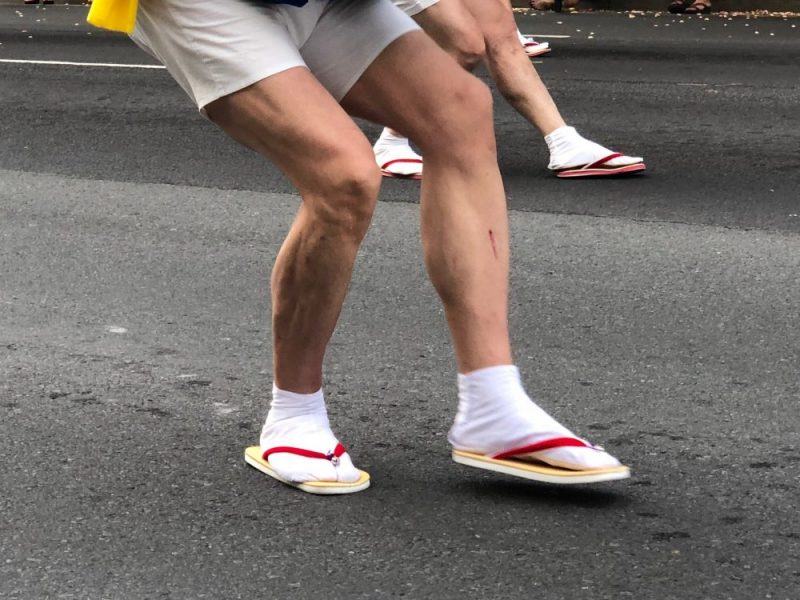
Will minimal shoes cause foot injury?
Yes, it is true that many people will advise you that minimal type shoes will cause you damage.
What they do not tell you, is that, if you have been wearing conventional shoes all your life,
then your feet have already been damaged and that damage will continue to occur.
If so, the conventional ‘knowledge’ from advisors will be for you to go down the path of forever
increasing the support in your shoes, including the addition of orthotics. The orthotics will then
be stiffened further.
We here at GeriTraK do not know your age or current physical condition. We cannot ethically provide
sight unseen clinical advice to individuals.
What we can say, however, is that human feet are designed for movement and are connected to the rest of
the human body that also works best with movement.
And, feet are alive.
Because feet are alive, they respond to situations where fitness can be maintained and improved by activity,
but at the same time feet can become unfit by not permitting them to move as designed.
Rigid shoes stop feet moving as designed and cause more stress up the leg and into the body. The stress adds up and begins to increase symptoms which some people than address by stiffening the foot up even further.
Actually, if humans did not wear such restrictive shoes in early and mid-life, the industry supporting even more
supportive devices would not exist, as we know it.
There is a lot going on when a person tries on a pair of shoes in a store, where the store employee will try to have the customer purchase the shoe with the greatest profit margin for the store. It is most often the case that the employee has no knowledge of human anatomy nor shoe movement dynamics, other than what the industry has told them.
An industry based on profit and further sales, supported by a secondary industry gaining more foot problems due to the damage over supportive shoes’ cause.
The sports shoe industry as we know it began around the 1960s. Since then, a lot of junk science has been undertaken
to justify what is seen in the stores today.
Back to trying on the new sports shoe. It feels nice on and makes the wearer feel that all shock is removed from
the walk-in store. Really comfortable. Plus, the shoe raises you up, so you feel a bit taller. The height raise gives
an immediate feeling of confidence that is a dopamine fix to be remembered. The shoe basically sells itself.
Nice colors, great advertising, looking cool with the latest.
BUT, that same cushy high shoe with stiff soles and great arch support is actually stopping your brain from knowing where the ground is because of the insulation. The forces around your ankle are raised because your foot cannot move properly and share the load between its twenty-six bones and up to sixty inter-articulations.
This can place people at greater risk of injury for ankle sprains or worse. Your reaction time is reduced because the brain will not gain the protective information it needs from the foot in time to take action.
If you begin to have injuries, then your foot health can be compromised. Best not to go down this path.
So, what is the answer?
Common sense. The longer a person has been wearing very supportive shoes, the longer it will take to gradually
unwind the artificial restrictions placed upon the ligaments, tendons, muscles, and bones in your feet.
The same way a new runner does not immediately try to run marathons, a person transitioning from control type shoe to
a more minimal shoe should be a gradual process.
Feet will need time to adapt. Increasing strength, flexibility, and balance.
Reversing the process.
Another analogy could be: a person who has not been active as a poor diet etc, is more at risk of illness. If they
are already showing signs of being unhealthy or are actually sick, it is understood that time will be necessary to
regain health.
Changing back to healthy footwear may take time. Same as everything else. Push things too fast when not ready, can cause problems. Just like anything else.
Obtaining guidance for any change in life is usually helpful. Such guidance should not come from those who have a paid
interest or bias in keeping an improper situation.
Minimal shoe types are difficult to come by as misinformation and profit have reduced the market availability.
Gaining the information necessary to transition from very supportive shoes to a less supportive shoe is even more
difficult, but not impossible. Finding a health professional with an understanding of the process and who has used minimal type footwear, would be an advantage.
But be very cautious of health professionals who wish to supply orthotics or other rigid devices.
These devices have their place in health care, but in our opinion, they are over-subscribed for the general population
as are highly shock absorbent, thick-soled, rigid and semi rigid-soled, big arch support, mechanically altering (pronation control), type shoes.
Good luck and happy foot use.
GeriTraK-Good To Know
2020